
Plants that live on winter rain
Native Canyon & Wildflower Seeding in San Diego, CA
Native grass, shrub and wildflower mixes for slopes and open ground that will never be lawn.
- No-charge site visit, with your estimate put in writing
- Seed mix matched to coastal or inland conditions
- A written watering plan with every new lawn
When Lawn Is the Wrong Answer
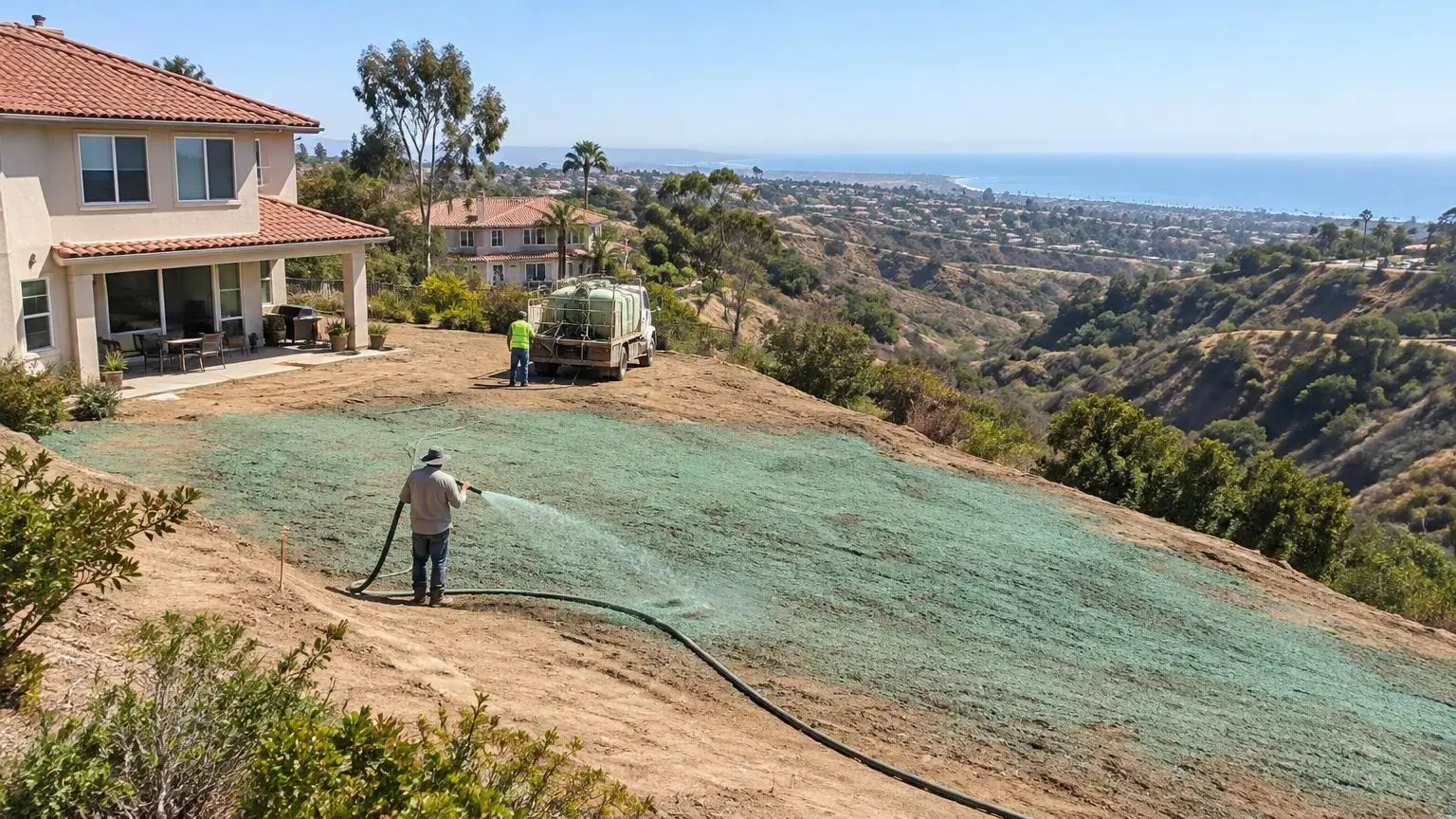
Native canyon and wildflower seeding is what we recommend in San Diego when the ground in question should not be lawn. That covers canyon slopes behind homes, cut slopes along driveways, brush-cleared zones, the back half of acreage lots, HOA slopes with failing irrigation, and areas where an owner simply wants something that does not need watering every summer. Native seeding uses a hydroseed slurry like any other job, but the seed mix is made up of grasses, shrubs and wildflowers adapted to a climate with almost no rain from May through September.
What grew here first
According to the city's natural history, most of what is now San Diego was originally coastal sage scrub on the west and chaparral on the east, both plant communities made up mostly of drought-resistant shrubs. Coastal sage scrub is low and aromatic, with drought-deciduous shrubs like California sagebrush, black sage, white sage, California buckwheat, coast brittlebush and golden yarrow, plus larger shrubs such as toyon and lemonade berry. San Diego County is also one of the places where maritime succulent scrub occurs. The USDA lists the native vegetation on Huerhuero terrace soils as including wild oats, soft chess, filaree, buckwheat and coastal sage, and on Vista granite soils as annual grasses and forbs with California sagebrush, scrub oak, chamise and flattop buckwheat. Those lists are a good starting point for what will actually survive on a given slope.
Why native mixes suit canyon slopes
A turf lawn on a canyon face needs regular irrigation all summer, and irrigation on a slope is exactly what feeds erosion and slumping. Native plants are built for the opposite: they germinate with the winter rains, grow through spring and go dry or semi-dormant in summer. Their roots go deeper than turf, which is what holds a slope long term. The trade-off is appearance. A native slope looks green and full in late winter and spring, then tan and gray through the dry months. If that is fine with you, it is usually the lowest-water, lowest-maintenance cover you can put on a slope here.
Fire and defensible space
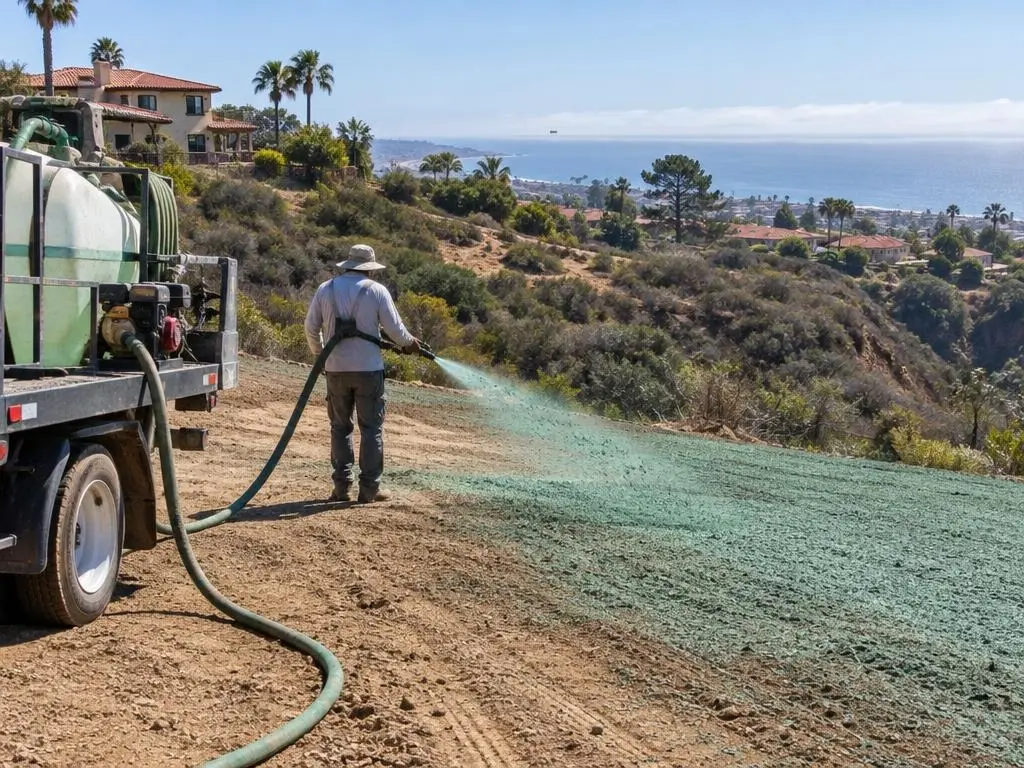
The chaparral and coastal sage scrub habitats around the city are prone to wildfire, and fire frequency increased through the 20th century, largely from fires starting near the edges of developed areas. The 2003 Cedar Fire burned about 280,000 acres and destroyed more than 2,200 homes, and in 2007 fires reached Rancho Bernardo, Rancho Santa Fe and Ramona. For seeding, that has two consequences. After a fire, burned slopes need cover quickly, and a native mix in a hydromulch or bonded fiber matrix protects them while plants recover. Near homes, where brush has to be thinned for fire safety, the seed mix should favor lower-growing grasses and wildflowers over tall shrubs. Your local fire agency's clearance rules come first, and we pick a mix that fits them.
Timing with the rain
Native seed in San Diego should go down in fall. The airport's normals add up to only about half an inch of rain from May through September, then about 1.7 inches in December, 2.0 in January and 2.2 in February. Seeding in October or November lets the first storms germinate the mix with no irrigation at all, and gives plants the full wet season to root before summer. Seeding in spring can work only if you can water the area through its first summer. Some years the rain simply does not come, as in the driest seasons on record with only about 3.2 inches, so a temporary drip or spray line on smaller areas is a cheap way to avoid losing a season.
Wildflower seeding
Wildflowers are a popular add-on to native grass and shrub mixes, particularly on open ground that can be seen from the house or the street. In a hydroseed application, wildflower seed is mixed into the slurry with the rest. Annual wildflowers give color in the first spring, while perennial grasses and shrubs take a season or two to fill in. Wildflower-only seedings tend to look sparse by the second year without some grass or shrub structure, so we usually blend them.
What to expect over two years
Native seedings fill in more slowly than a lawn. The first winter, the fastest annual grasses and wildflowers come up and give the slope some cover and color. Perennial bunchgrasses and shrubs germinate alongside them but stay small, putting energy into roots. By the second wet season, the perennials are larger and the slope starts to look like a planted area rather than a seeded one. During that time the mulch, tackifier and any blankets or BFM are doing the erosion work. Thin spots after the first spring are normal and are easy to patch with a second light application the following fall.
Preparing the ground
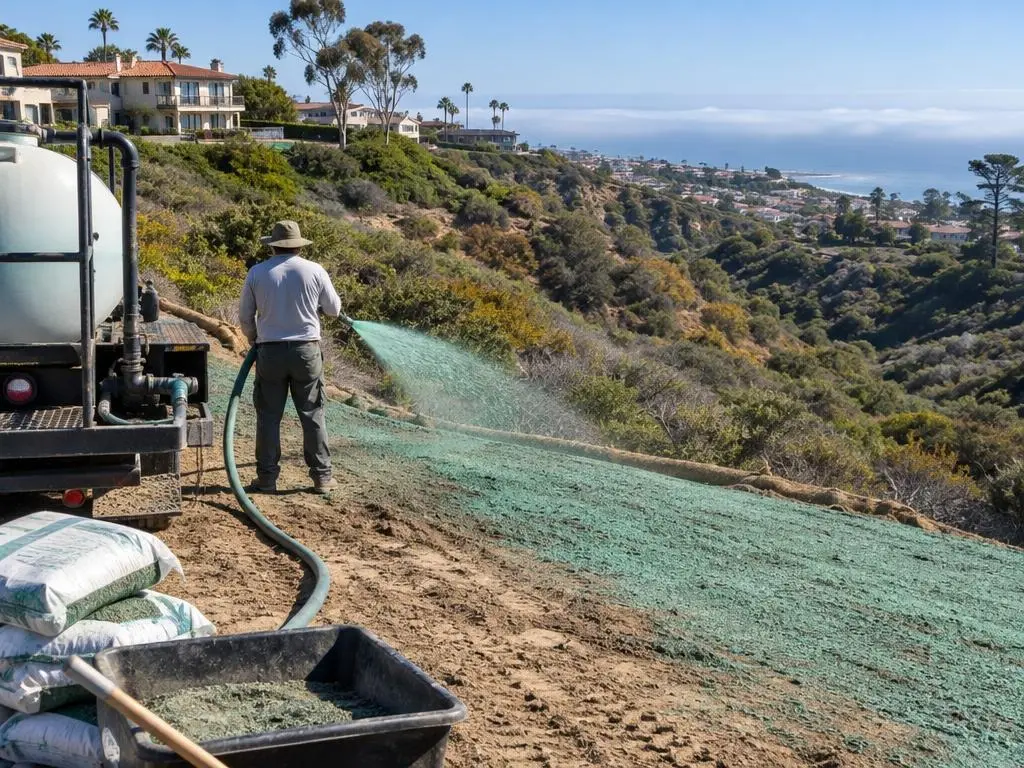
Native seed still needs soil contact and a weed-free start. We clear or mow existing weeds, rough up compacted surfaces so seed can lodge, fix any drainage that would wash the slope, and apply the seed with mulch and tackifier. On steep slopes the seed goes under or into a bonded fiber matrix or blanket. Weeds are the main competition, so expect some hand weeding or mowing of tall weeds during the first spring.
Native Seeding Work
Native mixes applied by hydroseed, with the cover the slope needs.
Canyon slope native mixes
Grasses, shrubs and forbs suited to coastal sage scrub and chaparral edges.
Wildflower blends
Annual and perennial wildflowers mixed with native grasses for color.
Post-fire seeding
Native seed in hydromulch or BFM to cover burned ground before the rains.
Fuel-break friendly mixes
Lower-growing natives for brush-cleared zones near structures.
HOA and acreage open space
Low-water cover for large areas that do not need lawn.
Weed control before seeding
Clearing and mowing so natives get a clean start.
Typical Native Seeding Costs
| Item | Typical range |
|---|---|
| Hydroseeding application, per sq ft (HomeGuide) | $0.12 to $0.35 |
| Hydroseeding application, per acre (LawnStarter) | $2,136 to $4,897 |
| Extra for slopes, per sq ft of hydroseed (HomeGuide) | $0.05 to $0.10 |
| 2025 state road erosion prices: wood-fiber hydromulch, per 1,000 sq ft | $98 |
| Native or wildflower seed mix | Quoted on site (no current published installed figure) |
Native seed costs vary widely by species, and no current published price for a contractor-installed native seeding was found, so the mix is priced after we see the site. Typical spans only. The quote document we send is the number you pay.
Native Seeding Step by Step
1. Site visit
Slope, soil, sun, fire clearance needs and how the area should look.
2. Pick the mix
Native grasses, shrubs and wildflowers chosen for the site.
3. Prep
Weed clearing, surface roughening and drainage fixes.
4. Apply in fall
Seed with mulch, tackifier and any BFM or blankets before the rains.
5. First spring
Weed control and a check on germination; touch up thin spots.
Why Choose Us for Native Canyon & Wildflower Seeding
Mix built for the site
Seed chosen from what grows on that soil and exposure.
Timed to the rains
Fall seeding so winter storms do the watering.
Fire-aware
Lower-growing mixes near structures, following local clearance rules.
Native Canyon & Wildflower Seeding Questions
Will a native slope stay green all year?
No. Native plants here green up with the winter rains and go tan or gray in summer. That is normal and is why they survive without irrigation.
When should native seed go down in San Diego?
October or November, so the December to March rains can germinate it and carry it into spring. Spring seeding needs irrigation through the first summer.
Do native slopes need irrigation?
Not once established, in most cases. A temporary line for the first season helps in a dry winter.
Can wildflowers be added to an erosion control job?
Yes. Wildflower seed mixes into the hydroseed slurry. We blend them with native grasses so the cover holds up after the first spring.
Is native seeding a good idea in a brush-clearance zone?
Often, if the mix is low-growing and you follow your fire agency's clearance rules. It covers bare soil without rebuilding the fuel load.
Native Canyon & Wildflower Seeding Service Areas
- Hydroseeding in San Diego, CA
- Hydroseeding in Chula Vista, CA
- Hydroseeding in Oceanside, CA
- Hydroseeding in Escondido, CA
- Hydroseeding in Carlsbad, CA
- Hydroseeding in El Cajon, CA
- Hydroseeding in Vista, CA
- Hydroseeding in San Marcos, CA
- Hydroseeding in Encinitas, CA
- Hydroseeding in Santee, CA
- Hydroseeding in Poway, CA
- Hydroseeding in La Mesa, CA
- Hydroseeding in Ramona, CA
- Hydroseeding in Alpine, CA
- Hydroseeding in Lakeside, CA
- Hydroseeding in Fallbrook, CA
- Hydroseeding in Bonita, CA
- Hydroseeding in National City, CA
- Hydroseeding in Solana Beach, CA
- Hydroseeding in Del Mar, CA
- Hydroseeding in Rancho Santa Fe, CA
- Hydroseeding in Imperial Beach, CA
Get a Native Canyon & Wildflower Seeding Estimate
Plan a native or wildflower slope before the rainy season.