
Slopes, swales and canyon rims
Canyon Slope Erosion Control in San Diego, CA
Keeping soil on the slope through a short, hard rainy season.
- No-charge site visit, with your estimate put in writing
- Seed mix matched to coastal or inland conditions
- A written watering plan with every new lawn
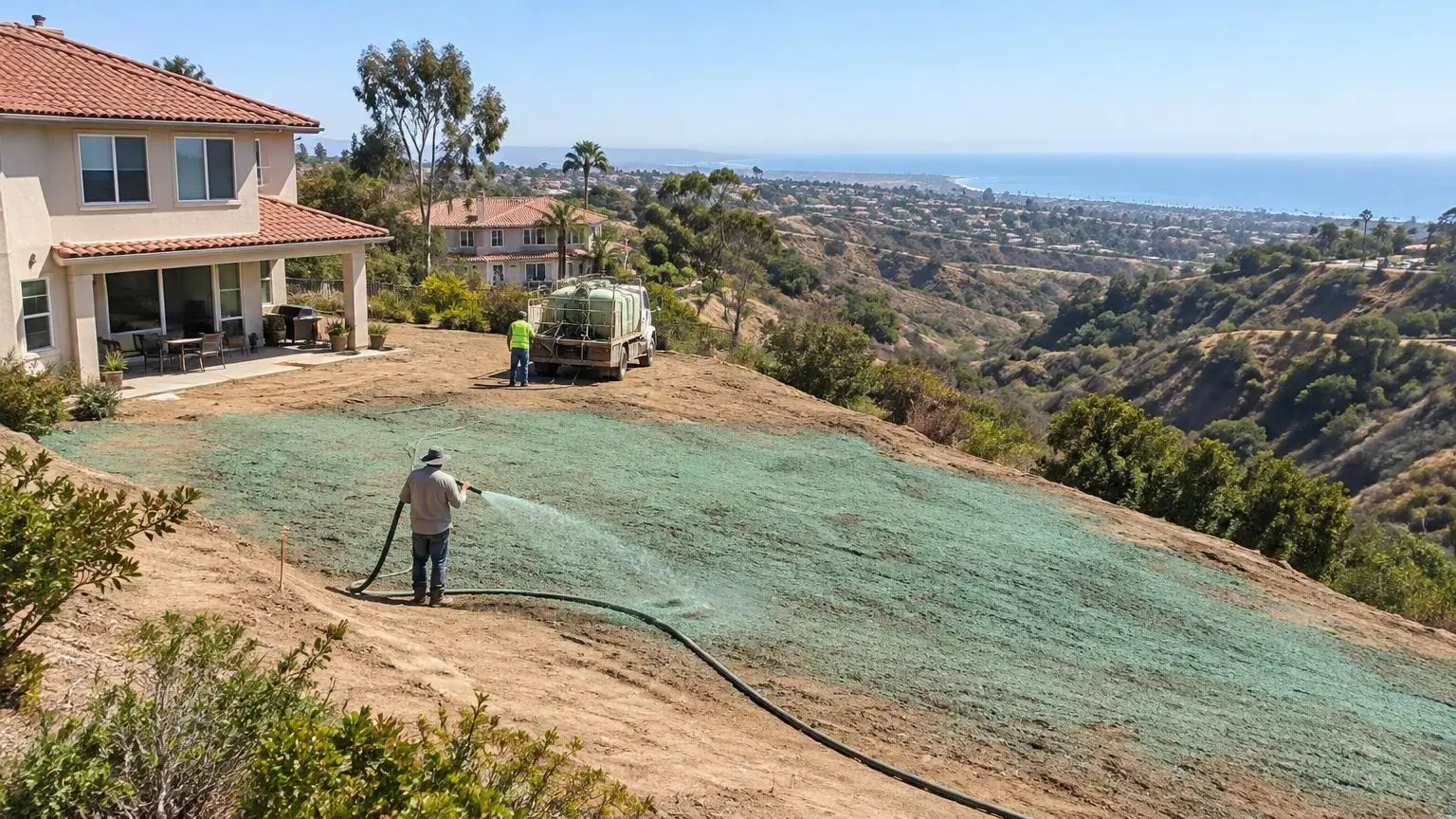
Where Mesa Lots Drop Into Canyons
Canyon slope erosion control is the work San Diego's geography makes unavoidable. The city is built on mesas with roughly 200 deep canyons between them, and a huge number of homes, streets and commercial lots sit right at the top edge. Below the rim, the slope is usually steep, dry most of the year, and covered with native brush or nothing at all. When a winter storm hits, water from the roofs, patios and driveways above runs straight over the edge, and if the face is bare it cuts rills and gullies within one season. As erosion control contractors we cover and stabilize those slopes with hydromulch, erosion control blankets or a bonded fiber matrix, plus the right seed, and we fix the drainage that is feeding the problem.
Why slopes here fail
Three things combine. First, the rain is concentrated: the airport's 1991 to 2020 normals put about 9.8 inches a year on the coast, mostly December through March, and storms can deliver a lot at once. Second, the slope surface is dry and loose by fall after months with almost no rain. Third, the soils are either slow-draining clay or loose granite. On marine terrace soils like the Huerhuero series, a dense clay subsoil sits under the surface and water moves through it very slowly, so runoff builds up and sheets downhill. On decomposed granite soils like the Vista series, found on hillsides with slopes up to 85 percent, the coarse sandy loam drains quickly but crumbles and washes once disturbed. Either way, bare ground on a slope does not stay where it is.
Fire scars and bare slopes
Coastal sage scrub and chaparral cover much of the undeveloped land around the city, and both burn. The October 2003 Cedar Fire burned about 280,000 acres and destroyed more than 2,200 homes in the region, and the October 2007 fires hit Rancho Bernardo, Rancho Santa Fe and Ramona. Burned slopes lose the roots and litter that held soil, and the first winter after a fire is when erosion is worst. Defensible-space clearing does a smaller version of the same thing to the slope behind a house. Where brush has been cut back or burned, we cover the face before the rains with hydromulch or a bonded fiber matrix and a seed mix that will put roots back into the soil.
Choosing the treatment
The right material depends on slope steepness, length, soil and how fast you need protection.
- Hydromulch (hydro mulching with wood or paper fiber and tackifier) is the light option for gentle slopes and short runs. It goes on in the same pass as seed.
- Bonded fiber matrix (BFM) is a heavier hydraulic product that dries into a continuous, bonded layer. It is our usual answer for steep canyon faces where blankets would be hard to anchor.
- Erosion control blankets and straw blankets are rolled out and stapled. Straw, straw and coconut, and coir versions last progressively longer. They are the go-to for swales, ditch lines and slopes that need protection right away.
- Fiber rolls placed across the slope on contour break up long runs of sheet flow.
Swales, ditches and the top of the slope
Most slope failures start above the slope. A downspout dumping onto a bare rim, a patio drain pointed at the canyon, or a yard graded toward the edge will undo any blanket. Before we cover a face, we look at where water arrives and how it leaves. Often the fix is a lined swale along the top that carries runoff to a stable outlet, a downspout extension into a rock energy dissipator, or regrading the yard so it drains toward the street. Our grading crews also dig the trenches for these drainage runs, so the erosion work and the water management are done together.
Slope stabilization with plants
Blankets and BFM buy time, but long-term slope stabilization comes from roots. On private canyon slopes we usually seed a native mix rather than turf, since the natural cover here is drought-adapted shrubs and grasses that can live on winter rain. On engineered slopes we follow the landscape plan. Either way, seeding in fall lets the December to March rains germinate the mix and carry it into spring. If the slope has irrigation, we can work later in the season.
What it costs
There is no reliable consumer price list for slope work, so we lean on public agency unit prices as a guide. The 2025 state road erosion prices we use as a benchmark put wood-fiber hydromulch at $98 for every 1,000 square feet, straw and coconut blankets at $468 per 1,000 square feet and coir blankets at $532. On the residential side, HomeGuide adds 5 to 10 cents a square foot to hydroseeding for steep slopes. We did not find a current published price for bonded fiber matrix, so BFM is quoted once we have walked the slope. Access is often the biggest factor on canyon jobs: if the truck cannot get near the rim, hoses get long and blankets get carried by hand.
Erosion Control Options
Matched to the slope, the soil and the season.
Hydromulch and seed
Fiber mulch with tackifier and seed for gentle to moderate slopes.
Bonded fiber matrix
Heavy hydraulic cover for steep canyon faces and long cut slopes.
Erosion control blankets
Straw, straw and coconut, or coir blankets stapled in place for immediate protection.
Swale and ditch lining
Blankets or rock in channels that carry concentrated flow.
Fiber rolls
Rolls on contour to slow sheet flow across long slopes.
Post-fire and brush-clearing cover
Cover for slopes stripped by fire or defensible-space clearing.
Top-of-slope drainage
Downspout extensions, swales and regrading so runoff stops pouring over the rim.
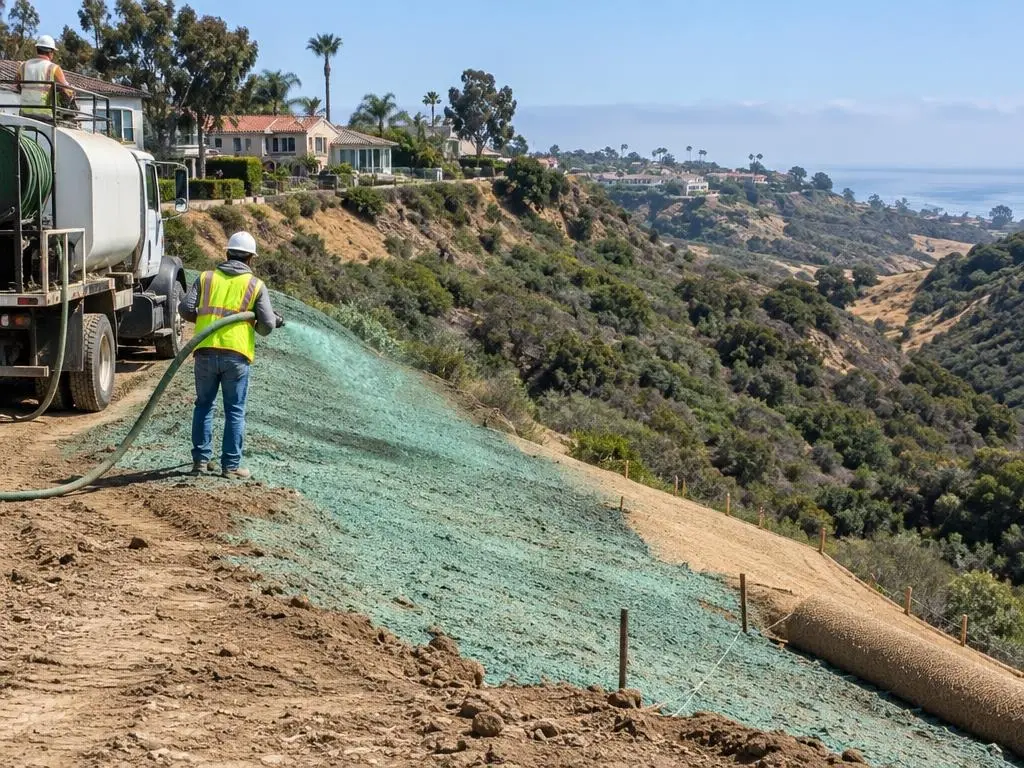
Typical Erosion Control Costs
| Item | Typical range |
|---|---|
| 2025 state road erosion prices: wood-fiber hydromulch, per 1,000 sq ft | $98 |
| Straw or coconut blanket, per 1,000 sq ft (same price list) | $468 |
| Coir blanket, per 1,000 sq ft (same price list) | $532 |
| Added cost on steep slopes, per sq ft of hydroseed (HomeGuide) | $0.05 to $0.10 |
| Bonded fiber matrix | Quoted after we walk the slope (no current published figure) |
Rate-schedule figures are public agency unit prices, not San Diego quotes. Slope, access and material choice drive the cost. Typical spans only. The quote document we send is the number you pay.
How We Stabilize a Slope
1. Walk the slope
Check steepness, soil, access, and where runoff comes from above.
2. Fix the water
Swales, downspout extensions or regrading at the top of the slope.
3. Prepare the face
Fill rills, track or roughen the surface, remove loose debris.
4. Cover and seed
Hydromulch, BFM or blankets with the seed mix, plus fiber rolls on contour.
5. Check after storms
Look for washouts and patch them early.
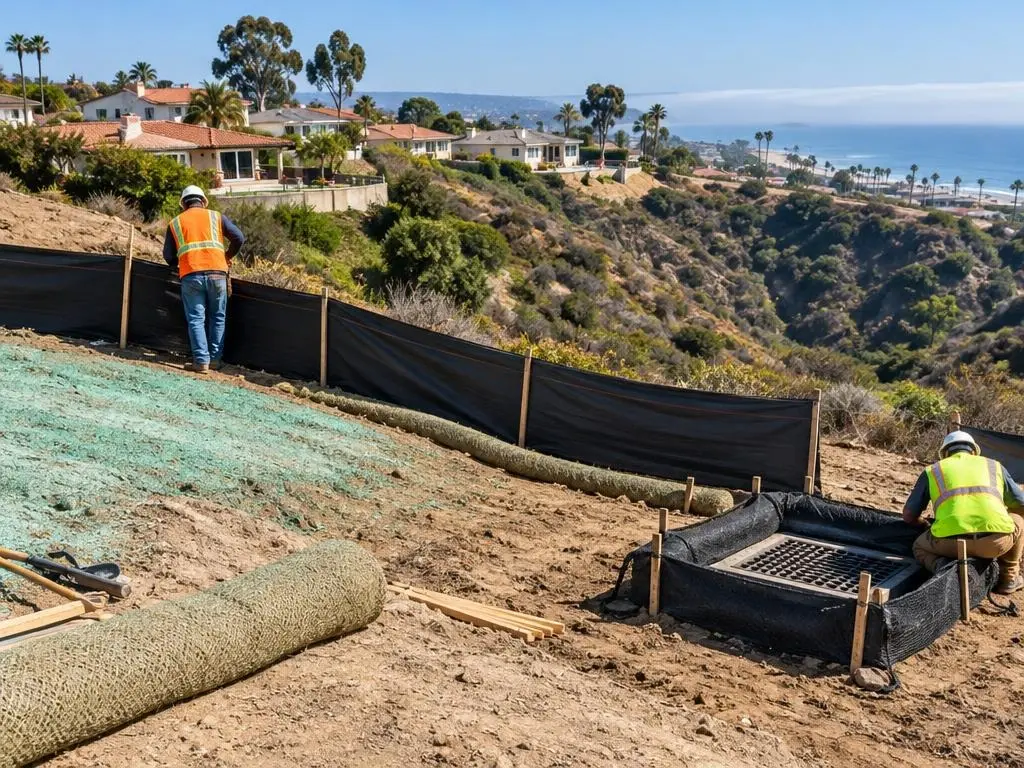
Why Choose Us for Canyon Slope Erosion Control
Drainage first
We fix what is sending water over the rim before covering the slope.
Right material for the grade
Hydromulch, BFM and blankets each have a place; we explain which and why.
Native-minded
On canyon slopes we lean toward plants that can live on winter rain.
Before the rains
We push to have slopes covered before December.
Canyon Slope Erosion Control Questions
Hydromulch or bonded fiber matrix: which one does my slope need?
Hydromulch is a lighter fiber mulch with tackifier, good on gentle slopes. Bonded fiber matrix is a heavier hydraulic product that cures into a continuous bonded layer and holds up on steep slopes where lighter mulch would wash.
What do your erosion control services include?
Slope assessment, drainage fixes at the top of the slope, surface prep, and cover with hydromulch, bonded fiber matrix, straw blankets or coir blankets plus seed. We also install fiber rolls and silt fence where runoff needs to be slowed or filtered.
Do I need erosion control blankets or is hydroseed enough?
On gentle, short slopes hydroseed with good tackifier is often enough. Swales, ditch lines and steep or long slopes usually need blankets or BFM, at least until plants root in.
When should I cover a canyon slope?
Ideally in October or November, before the December to March rains. That gives the mulch time to set and lets the first storms germinate the seed instead of eroding bare soil.
Can you work on a slope you cannot drive to?
Yes. We run long hoses from the street for hydraulic products and hand-carry blankets. Access affects the price, so we look at it on the visit.
My slope was cleared for fire safety. Will it erode?
Removing brush takes away much of what held the surface. Leaving roots in place where allowed helps, and a hydromulch or BFM cover with a low-growing seed mix protects it through the first winter.
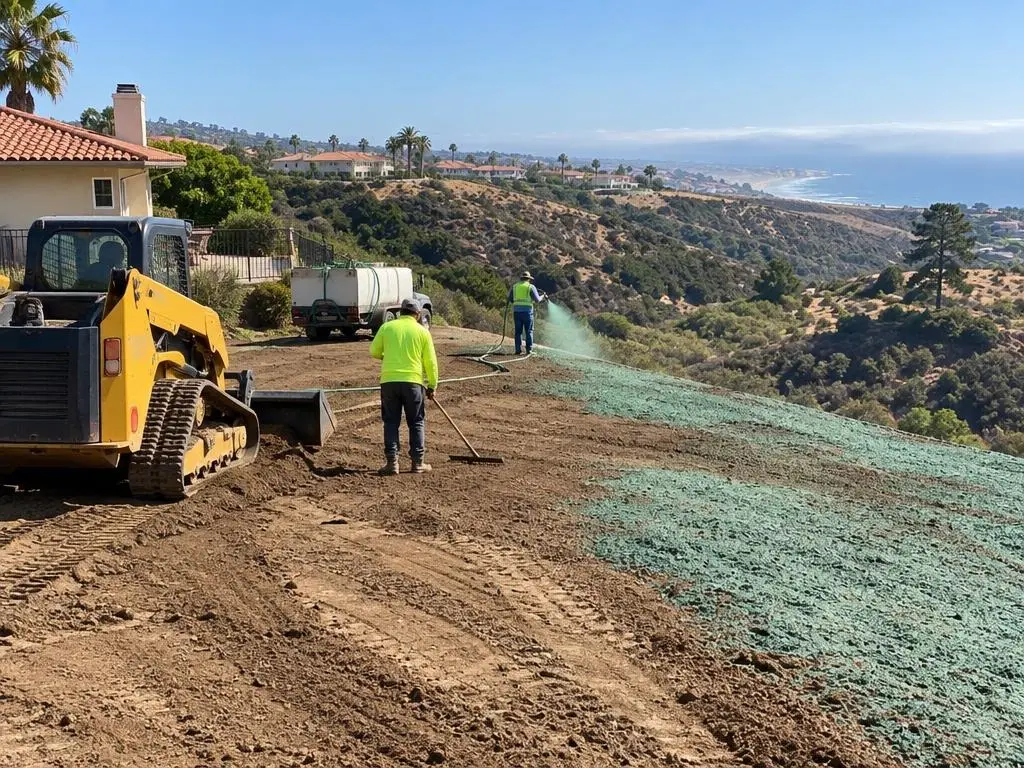
Canyon Slope Erosion Control Service Areas
- Hydroseeding in San Diego, CA
- Hydroseeding in Chula Vista, CA
- Hydroseeding in Oceanside, CA
- Hydroseeding in Escondido, CA
- Hydroseeding in Carlsbad, CA
- Hydroseeding in El Cajon, CA
- Hydroseeding in Vista, CA
- Hydroseeding in San Marcos, CA
- Hydroseeding in Encinitas, CA
- Hydroseeding in Santee, CA
- Hydroseeding in Poway, CA
- Hydroseeding in La Mesa, CA
- Hydroseeding in Ramona, CA
- Hydroseeding in Alpine, CA
- Hydroseeding in Lakeside, CA
- Hydroseeding in Fallbrook, CA
- Hydroseeding in Bonita, CA
- Hydroseeding in National City, CA
- Hydroseeding in Solana Beach, CA
- Hydroseeding in Del Mar, CA
- Hydroseeding in Rancho Santa Fe, CA
- Hydroseeding in Imperial Beach, CA
Get a Canyon Slope Erosion Control Estimate
Get your slope covered before the first big storm.