
Hills, valleys and sandy granite soil
Hydroseeding in Vista, CA
Seeding on coarse, fast-draining soil in the town once promoted as the avocado capital of the world.
- No-charge site visit, with your estimate put in writing
- Seed mix matched to coastal or inland conditions
- A written watering plan with every new lawn
Getting Grass to Hold on Granite Soil
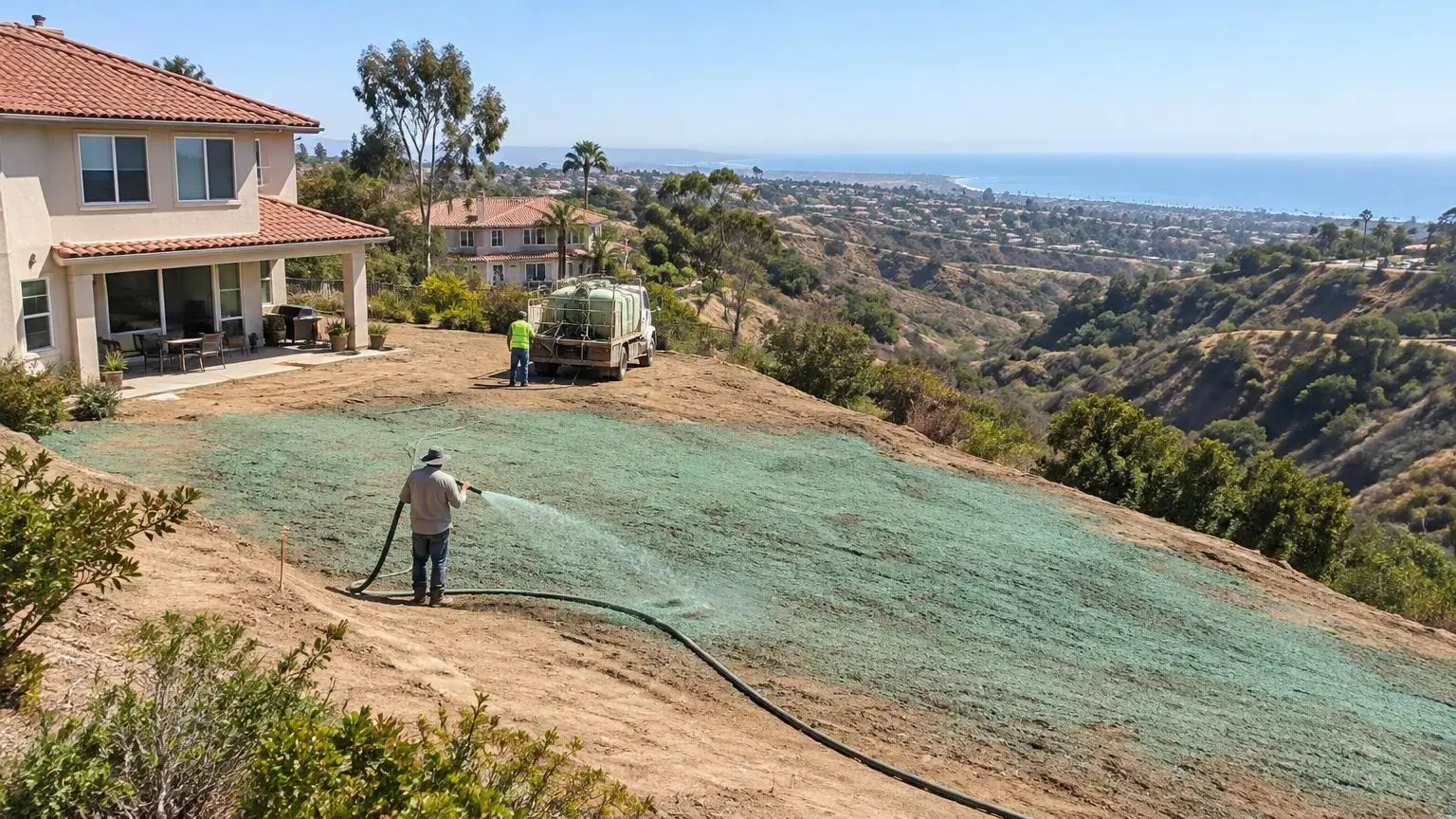
Hydroseeding in Vista means working with soil that lets water go fast. The landscape is marked by hills and valleys, and the area's soils include the Vista series, a coarse sandy loam formed in material weathered from decomposed granite. USDA describes it on hills and uplands with slopes from 2 to as much as 85 percent and moderately rapid permeability. Water soaks in quickly, but it does not stay near the surface where new roots need it.
What that means for a new lawn
On coarse granitic soil, we work in topsoil or compost before seeding so the top few inches hold more moisture. We use a full hydromulch rate to shade the seed bed, and we set irrigation for short, frequent cycles during germination. Once the lawn fills in, longer cycles train roots deeper into the soil.
Slopes that ravel
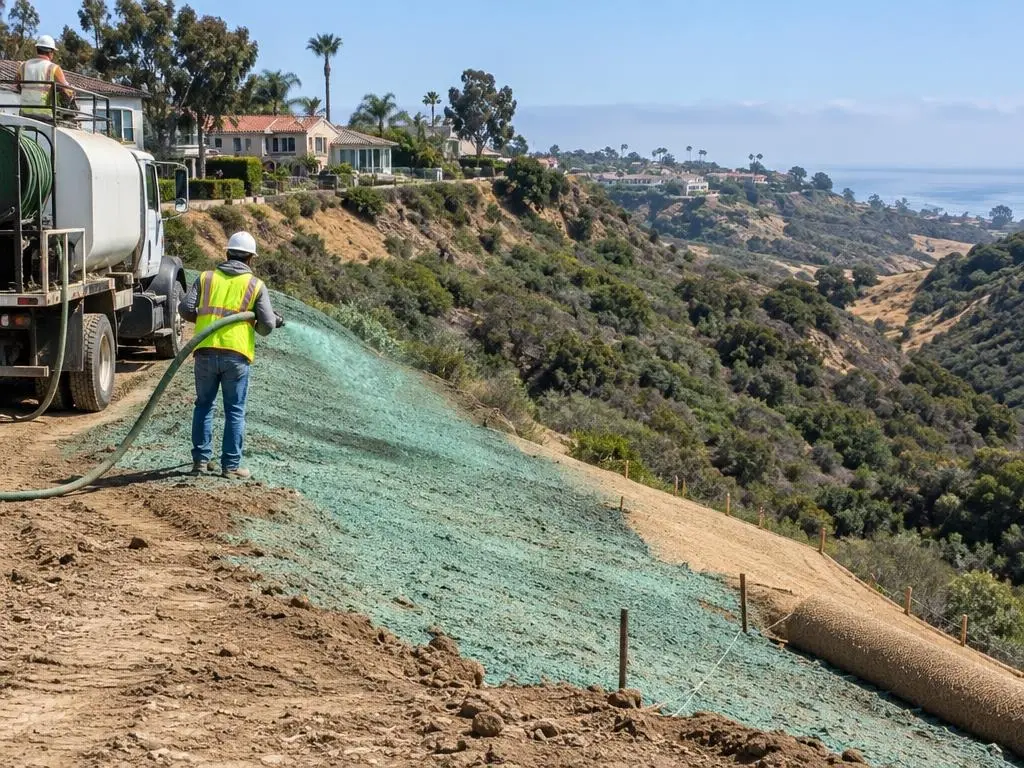
Decomposed granite on a steep cut tends to ravel, shedding grains downhill every time it rains or the wind blows. Bare slopes in Vista respond well to either a pinned erosion blanket or a sprayed bonded fiber matrix, which lock the surface while seed takes root. Fiber rolls along the contour slow any water that does run off.
Rain and temperature
Vista averages a little over 13 inches of rain a year, with most falling between November and April. February and January are the wettest months; August averages just 0.03 inch. Extremes are uncommon, frost is quite rare and the last significant snow was in 1967. That mild range gives a long seeding season, though summer seedings still need careful watering.
From groves to neighborhoods
After a 1920s water project, Vista grew citrus, tomatoes, celery and avocados, and by the late 1940s it was promoted as the avocado capital of the world. Housing booms from the 1970s through the early 2000s replaced much of that farmland. Older grove terraces and irrigation remnants still turn up during yard grading.
Vista services we provide
- Lawn seeding with soil amendment
- Slope stabilization on granite cuts
- Grading and old-grove cleanup
- Lawn repair and overseeding
To book a Vista visit, get a free estimate or call (619) 673-9356.
Vista Soil and Climate
- Vista soil series. USDA's Vista series is a coarse sandy loam from decomposed granite, on slopes of 2 to 85 percent with moderately rapid permeability.
- Terrain. Vista's landscape is marked by hills and valleys, with chaparral, oak woodland and oak-grass savanna in undeveloped areas.
- Avocado history. By the late 1940s Vista was promoted as the avocado capital of the world before housing replaced much of the farmland.
- Rainfall. Most of Vista's roughly 13 inches of annual rain falls November to April; August averages 0.03 inch.
Vista Questions
Why does my yard dry out so fast after watering?
Coarse granitic soil drains quickly. Adding topsoil or compost before seeding helps the root zone hold more water.
My cut slope keeps shedding sand onto the patio. What fixes that?
A bonded fiber matrix or erosion control blanket holds the surface while seed roots in, and fiber rolls slow runoff at the base.
Can you seed year-round in Vista?
Frost is rare, so the season is long. Fall through early spring is easiest; summer seeding needs more frequent watering.
Do you remove old grove irrigation before seeding?
Yes. We pull out old pipe and risers during grading so they do not cause lumps or leaks under the new lawn.
Free Estimates in Vista, CA
Send us your Vista address for a written estimate.
Hydroseeding Near Vista
- Hydroseeding in San Diego, CA
- Hydroseeding in Chula Vista, CA
- Hydroseeding in Oceanside, CA
- Hydroseeding in Escondido, CA
- Hydroseeding in Carlsbad, CA
- Hydroseeding in El Cajon, CA
- Hydroseeding in San Marcos, CA
- Hydroseeding in Encinitas, CA
- Hydroseeding in Santee, CA
- Hydroseeding in Poway, CA
- Hydroseeding in La Mesa, CA
- Hydroseeding in Ramona, CA
- Hydroseeding in Alpine, CA
- Hydroseeding in Lakeside, CA
- Hydroseeding in Fallbrook, CA
- Hydroseeding in Bonita, CA
- Hydroseeding in National City, CA
- Hydroseeding in Solana Beach, CA
- Hydroseeding in Del Mar, CA
- Hydroseeding in Rancho Santa Fe, CA
- Hydroseeding in Imperial Beach, CA