
Mesas, canyons and a short rainy season
Hydroseeding in San Diego, CA
Grass and slope cover for a city split by roughly 200 canyons, where most rain arrives in four months.
- No-charge site visit, with your estimate put in writing
- Seed mix matched to coastal or inland conditions
- A written watering plan with every new lawn
Seeding a City of Mesas and Canyons
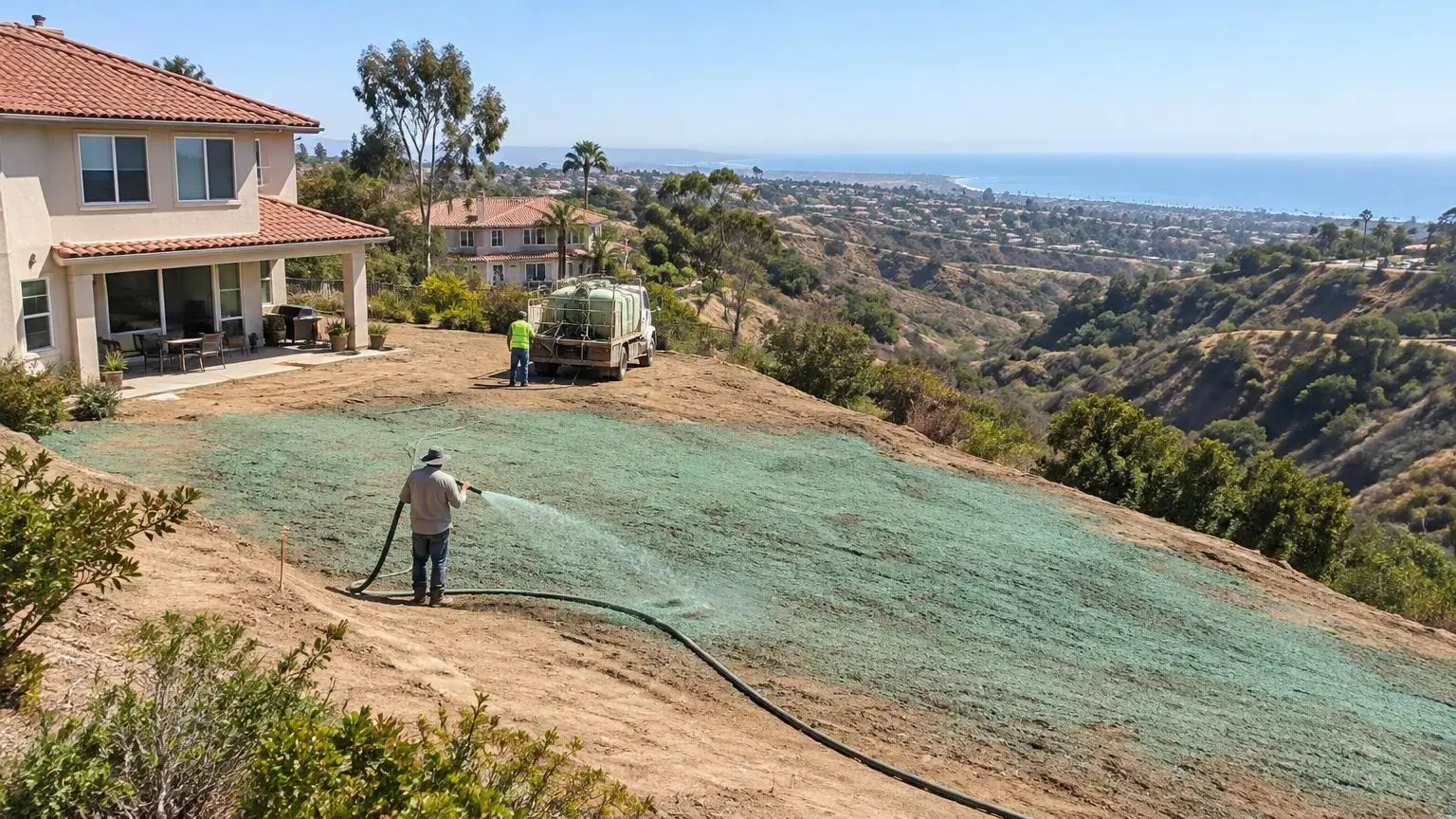
Hydroseeding in San Diego starts with the shape of the land. The city is a patchwork of mesas separated by approximately 200 deep canyons and hills, and most neighborhoods were built on the flat mesa tops while the canyons were left wild. That means a lot of backyards end at a canyon rim, and a lot of new lawns sit just uphill from a slope that sheds water the moment it rains.
Rain comes in a narrow window
Most of San Diego's precipitation falls between December and March, and May through September is almost completely dry. Coastal totals average about 10.65 inches a year, but the swing between years is huge: some seasons have topped 24 inches and the driest have seen as little as 3.2. A fall application lets winter rain help with germination; a late spring job means the lawn depends on irrigation from the first week.
Coast versus inland
The marine layer known as May gray and June gloom keeps coastal neighborhoods cool and damp, then usually clears 5 to 10 miles inland. Seed near the beach dries out slowly and can stay green with less water; seed in the eastern neighborhoods needs a tighter watering schedule and a heavier mulch layer to hold moisture.
Canyon edges and slope cover
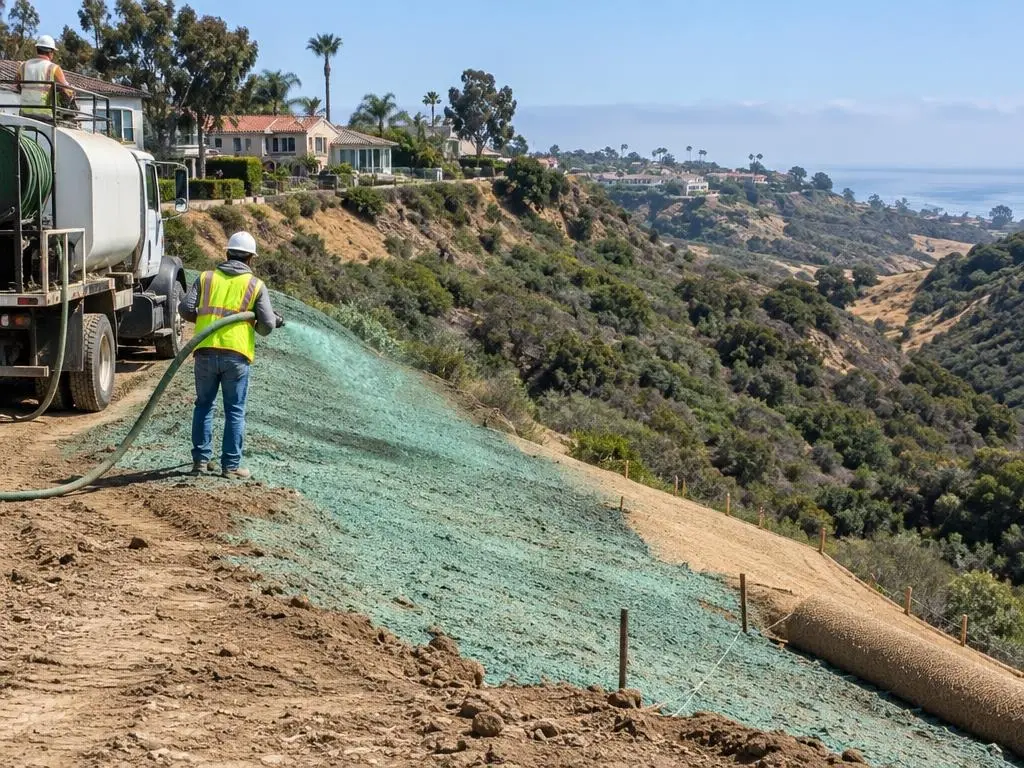
The western part of the city was originally covered in coastal sage scrub and the eastern part in chaparral. Where a yard meets that native cover, we often recommend hydromulch or a bonded fiber matrix on the slope face instead of turf, plus a silt fence or fiber rolls at the toe while the cover fills in. On canyon-edge lots our grading crews also cut swales and dig drainage trenches so roof and patio water stops running straight over the rim.
Heavy clay pockets
Some San Diego County soils, such as the Huerhuero series mapped on old alluvial fans and marine terraces, carry 35 to 45 percent clay in the subsoil and have very slow water movement. On ground like that, we rip compacted fill, add topsoil where it is thin and keep irrigation cycles short so water soaks in instead of sheeting off.
Work we handle across the city
- New lawn installation on mesa-top lots
- Slope stabilization above canyons
- Silt fence and inlet protection for builders
- Yard grading, topsoil and drainage trenching
- Lawn repair and overseeding on thin turf
Get a free estimate or call (619) 673-9356.
San Diego Ground Conditions
- Canyons and mesas. About 200 deep canyons and hills separate the city's mesas; neighborhoods were mostly built on mesa tops while canyons stayed wild.
- Rainy season. Most precipitation falls December through March, coastal rainfall averages 10.65 inches, and May to September is almost completely dry.
- Native cover. The west side was originally coastal sage scrub and the east side chaparral, both made up of drought-resistant shrubs.
- Cedar Fire. The October 2003 Cedar Fire burned 280,000 acres and destroyed more than 2,200 homes in the region.
- Clay soils. The Huerhuero soil series of San Diego County has 35 to 45 percent subsoil clay and very slow saturated hydraulic conductivity.
San Diego Questions
My backyard ends at a canyon. Should the slope get grass too?
Usually not. Turf on a steep canyon face needs a lot of water and still erodes. We normally put a bonded fiber matrix or native seed mix on the slope and keep the lawn on the flat part of the lot.
Which part of the year gives San Diego hydroseed the best start?
Early fall is a strong choice because the December to March rains follow soon after. Spring seeding works too, but the lawn will depend entirely on irrigation through the dry summer.
Does it matter if I live near the coast or farther inland?
Yes. The marine layer keeps coastal yards damp into June, while neighborhoods 5 to 10 miles inland get more sun and heat. We adjust mulch rate and the watering plan to match.
What if a big storm hits right after seeding?
Tackifier in the hydromulch helps hold seed in place, and on slopes we add fiber rolls or silt fence at the bottom. Minor touch-ups after a hard storm are normal and are part of how we plan the job.
Free Estimates in San Diego, CA
Tell us about your mesa lot or canyon slope and we will send a written estimate.
Hydroseeding Near San Diego
- Hydroseeding in Chula Vista, CA
- Hydroseeding in Oceanside, CA
- Hydroseeding in Escondido, CA
- Hydroseeding in Carlsbad, CA
- Hydroseeding in El Cajon, CA
- Hydroseeding in Vista, CA
- Hydroseeding in San Marcos, CA
- Hydroseeding in Encinitas, CA
- Hydroseeding in Santee, CA
- Hydroseeding in Poway, CA
- Hydroseeding in La Mesa, CA
- Hydroseeding in Ramona, CA
- Hydroseeding in Alpine, CA
- Hydroseeding in Lakeside, CA
- Hydroseeding in Fallbrook, CA
- Hydroseeding in Bonita, CA
- Hydroseeding in National City, CA
- Hydroseeding in Solana Beach, CA
- Hydroseeding in Del Mar, CA
- Hydroseeding in Rancho Santa Fe, CA
- Hydroseeding in Imperial Beach, CA